

Rating of
3.5/5
Nostalgia Bait: The Game
Nelson Schneider - wrote on 08/30/26
“Dragon Quest Treasures” (“DQT”) is the latest spinoff of the venerable ‘Dragon Quest’ series, which is, itself, a cultural institution within Japan’s videogame sector. In recent years, a significant portion of Square-Enix’s portfolio of flagship franchises have been farmed out to external development studios, both for ports and for smaller-scale spinoff titles, and “DQT” is no different, as the product of TOSE Software. TOSE is a venerable Japanese institution all on its own, contributing to thousands of game development projects (often uncredited) since its founding in 1979. The first time TOSE dipped its fingers into ‘Dragon Quest’ was with the “Dragon Quest Monsters 1 + 2” compilation in 2002 (which remained Japan exclusive). Square-Enix apparently liked their work, though, as later they would become the lead developers for “Dragon Quest Monsters: Caravan Heart” and “Slime Quest” in 2003 (both Japan exclusive), and eventually made the stewards of the entire ‘Dragon Quest Monsters’ IP, which they proceeded to ruin with the ‘Joker’ arc on the DS.
Prior to the 2022 release of “DQT,” TOSE’s last ‘Dragon Quest’ project was the 2015 3DS port of “Dragon Quest 8: Journey of the Cursed King.” In the mean time, though, TOSE has been keeping busy with other Square-Enix projects, most notably the ‘Pixel Remaster’ re-releases of the original 6 ‘Final Fantasy’ titles.
Personally, I have always loved ‘Dragon Quest,’ dating all the way back to the NES era when the games were both terrible and dubiously localized for the North American market. I will generally buy anything with the ‘Dragon Quest’ (or ‘Dragon Warrior’) logo slapped on it, and “DQT” was no different. I didn’t do any research into what the game was supposed to be, since ‘Dragon Quest’ has remained the only IP Square-Enix controls that they haven’t completely ruined yet. What I found in “DQT” is a somewhat rough and unpolished Sandbox game that looks to cash-in on the nostalgia of long-time ‘Dragon Quest’ fans like myself, yet only partially succeeds due to a myriad of small issues that add up to a mostly mediocre experience.
Presentation
“DQT” was originally developed for the Nintendo Switch... and you can really tell in the PC port. Even when running the game at a higher resolution, like 1080p or 4K, the internal resolution never improves beyond what the original Switch was capable of, giving the entire game a bit of a blurry and claustrophobic feel with its too-close camera angle. Most things in the game are cell-shaded, and the textures look pretty good, but that only applies during live gameplay. The handful of pre-rendered cutscenes for important story beats look absolutely terrible, and remind me (unfondly) of the low-resolution FMVs of 5th Gen PlayStation and PC games. Interestingly, “DQT” was built, not from scratch, but in the Unreal Engine – which isn’t something a lot of Japanese developers do. Perhaps the game’s lack of sharpness and clarity is due to the extra overhead of the Unreal Engine... but it’s more likely that TOSE just didn’t bother to change anything for the PC port and left all of the low-quality Switch settings intact.
Regardless of that, “DQT” does an admirable job of continuing to use and re-use similar 3D polygonal assets to those first made for “Dragon Quest 8” on the PlayStation 2 – which was the series’ first foray into fully polygonal visuals. Toriyama’s monster designs are all in there, Sugiyama’s soundtrack is all in there. Those guys are still 2 of the top 3 names in the game’s credits, even though they’re dead. Yuji Horii, the series’ lead and director is still alive, and is the other top name in the credits. So TOSE’s reputation of being a ‘ninja developer’ that hates taking credit is on full display.
Speaking of soundtrack, Sugiyama’s excellent tunes are all crammed into “DQT,” with each major area having its own overworld music, ripped straight out of past ‘Dragon Quest’ games. However, there are a couple of new tunes in the soundtrack that I didn’t particularly like (or recognize from past games). The game’s voiceacting, however, is not exactly excellent, and it’s more in the way it’s handled than the absolute quality of the voice work. Only a handful of cutscenes have full voiceover. The rest of the game’s text-heavy dialog will see characters say the first few words of their dialog, leaving the player to read the rest. The absolute worst offense in the game’s audio, though, is the fact that the variety of recruitable monsters that accompany the main characters while exploring CONSTANTLY say stupid things... and they’re the SAME things over and over and OVER! If you’ve experienced the annoyance of “Dragon’s Dogma’s” Pawns saying “FIRE WORKS WELL!” and “WOLVES HUNT IN PACKS!” over and over... “DQT’s” companion banter is EVEN WORSE! Unfortunately, there’s no way to turn off companion banter without turning off voiceacting altogether... but I had to disable voices to preserve my sanity. I haven’t had to do that since I played “Arc Rise Fantasia” on the Wii.
Technically, “DQT” is pretty solid. Other than the issues with the resolution and non-granular control of voiceacting, the game doesn’t really have any issues. It supports Xinput out of the box, and, unlike so many other Japanese games, allows for fairly free-form re-binding of controller inputs (which is necessary, since the defaults are incredibly stupid). The game is stable and never crashed on me, plus it includes auto-saves (which don’t save quite as often as I’d have liked) and the ability to save anywhere. This freedom to save anywhere is necessary, though, as unlike every other ‘Dragon Quest’ game or spinoff, dead is dead, instead of reviving the player with half their gold.
Story
“DQT” tells the backstory of Erik and Mia, two characters from the most recent mainline ‘Dragon Quest’ title, “Dragon Quest 11.” Erik is a thief and a self-styled treasure hunter, and in “Dragon Quest 11,” we learn that he and his sister grew up as de-facto slaves to a tribe of Vikings and spent a significant amount of time aboard a longship. However, because they had a destiny ahead of them, Erik and Mia actually spent quite a bit of time during their childhoods away from the Vikings’ oppression, exploring another world filled with treasure.
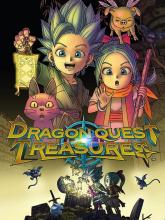
One fateful evening, Erik and Mia are sneaking out of the longship’s hold – as they frequently do while the Vikings are too drunk to notice – when they encounter a pair of bizarre creatures the Vikings have captured: A pink, bat-winged cat and a green, dragonfly-winged pig. The kids release these creatures from captivity and follow them to a small island where a mysterious ruin beckons them. Within the ruin, they discover a pair of bejeweled daggers that suddenly allow them to understand the strange creatures that lead them there. It turns out that the cat, Purrsula, and the pig, Porcus, are not actually monsters, but low-ranking divine functionaries of the gods, sent to retrieve seven magical Dragon Stones before they’re allowed back into Heaven. Purrsula and Porcus led the kids to the magic daggers that allow them to open a portal to the parallel world where the dragon stones are, based on an old legend about saviors with blue eyes.
Erik and Mia excitedly agree to the deal, and soon find themselves transported to Draconia, a world of endless sky, dotted by floating islands formed from the petrified corpses of 2 enormous dragons. It doesn’t take long for the kids to learn that Draconia has a native population of humans, plus a butt-load of friendly (and unfriendly) monsters. The primary industry in Draconia is treasure hunting, as the dragon corpses that makeup the world are absolutely riddled with valuable objects that commemorate the histories of other worlds. Unfortunately, Draconia has fallen on somewhat hard times, with the steampunk railway system that once connected the entire world having fallen into disrepair after its founders’ disappearance (and presumed death), while rival gangs of treasure hunters and sky pirates wage never-ending turf wars.
Thrown into this bizarre new world, Erik and Mia suddenly find themselves the leaders of a new treasure hunting gang with the responsibility to not only help Purrsula and Porcus find the Dragon Stones they’re after, but to restore the Transdraconia Railroad to its former glory.
While there is plenty of story material to work with in “DQT,” a lot of it feels incredibly rushed. Early on, we’re introduced to a villain – an undead Jamaican pirate named Long John Silverbones – who is made out to be a big scary threat... but who doesn’t show up again until the very end of the game. Silverbone’s crew also contains a number of named characters that are introduced in the style of overpopulated shonen anime, but next to none of them get any real character development, and I found it impossible to remember their names by the time they showed up again in the main narrative.
Rather than really having a compelling plot with well-structured narrative arcs, “DQT” tends to lean on nostalgia to keep the player’s attention. In a way, “DQT” reminds me a lot of “Super Smash Bros.: Melee,” in that the nostalgia comes primarily in the form of a vast array of collectible statues of various heroes, villains, and objects from previous ‘Dragon Quest’ games. However, while the ‘trophies’ in ‘Smash’ are just extra bonuses, the collectibles in “DQT” are the entire point and central focus of the gameplay. Unfortunately, I found that the game kept giving me objects from games for which a don’t (and can’t) have any nostalgia, like “Dragon Quest 10,” an MMORPG that never got released outside of Japan. I also played fanslations of numerous games in the series (or the original, butchered ‘Dragon Warrior’ localizations on the NES/Game Boy), and haven’t re-played any of the more recent remakes with consistent, new localizations, so even the things that should trigger nostalgia in me look different and have different names than what I actually remember.
Still, it’s not a complete disaster, and there are some decent story arcs revolving around the Transdraconic Railroad, Princess Anemone’s historical research, and, of course, the Dragon Stones that manage to resolve satisfactorily over the basic game’s roughly 30-hour duration. However, the post-game is so riddled with extra-long dragged-out questing involving superfluous side-characters and excessive collect-a-thon-ing that I can’t say I’d ever be compelled to keep playing or replay this game in the future.
Gameplay
“DQT” is a ‘Dragon Quest’ spinoff that attempts to combine a less-detailed version of the monster-catching mechanics of the ‘Dragon Quest Monsters’ spinoff series with Action-based real-time combat and a massive, sprawling open world filled with tchotchkes to collect. The player can choose to control either Erik or Mia – never both at once, but they do level up simultaneously – and can recruit monsters from a fairly limited selection of heavily pallet-swapped critters from ‘Dragon Quest’s’ past (plus a few new ones).
Being children, Erik and Mia aren’t exactly powerful or capable in most ways. They can attack with a single, clunky combo using their magic daggers or deploy a slingshot to fire a huge variety of pellets into the fray, either to damage or debilitate enemies, or to heal or buff allies. The team can contain up to 3 recruited monsters at any give time, though the player generally has very little control over what these allies do at any given time. There’s no way to tell them to save MP or go all-out... they just tend to spam their best attacks at all times, while Erik or Mia can only tell them to “Go, go, go!” or “Gather ‘round!” which I found to be very inconsistent. Indeed, I found it all too common of an occurrence for my monster companions to get stuck or separated from the group and not actually respond to commands to regroup. Even worse, while traveling through high-level areas at night when most of the wild monsters are asleep, instead of sticking close-by and staying out of trouble, my team would constantly provoke enemies they shouldn’t have.
Another thing the party’s monster recruits can do, besides engage in real-time combat, is to execute their species-specific Forte. Each Forte is a movement or environmental ability that aids Erik and Mia in exploring the world. Slimes’ Forte allows them to bounce the kids up much higher than a regular jump. Flying monsters can glide with their Forte. Ghosts and mud monsters can stealthily burrow underground. Orcs and the like can use their acute senses to highlight resources and chests in the immediate area. Finally, a wide variety of monsters ranging from Saber Cats to Golems can be ridden in order to boost the kids’ pathetically-slow movement speed. Unfortunately, with only 3 monster slots in the party, two Fortes will be left by the wayside... and it’s almost always going to be Search and Sprint, as the other three Fortes are far too important for moment-to-moment exploration, while the others are just kind of ‘nice to have.’
Another unfortunate aspect of the game’s monster-centric party is that each monster recruit comes with a handful of fixed combat skills and passives drawn from a larger pool based on its species. Do you want a decently powerful slime-type monster that can cast healing spells? Well, you get one as part of the initial story beat... but if you want to replace that one with a King Slime, you’ll be stuck farming King Slimes until you luck into recruiting one that knows Heal/Midheal/Fullheal (dependent on level), since it’s impossible to swap out any of the intrinsic skills or passives that monsters come with.
The core of the gameplay is treasure hunting, though, which is also handled by monsters. At any point Erik or Mia can use a treasure sense ability to have a compass needle point them toward the nearest buried treasure. Once close enough, the compass needle will spin wildly, and the party’s monsters will each telepathically show the kid a screenshot of where the treasure actually is. It’s then up to the player to scour the immediate environment for a matching spot, which will emit a rainbow glow when directly in top of it. Then it’s just a matter of digging it up (with a slow animation) and handing it to one of the party’s monsters to carry around. Each monster can only hold 2-3 treasures, and not all monsters have strong grips, meaning they can drop treasures if they’re hit by enemy attacks. Less valuable treasures don’t require the treasure compass to track them down, but all of them contribute to the party’s total treasure capacity. Once loaded up with loot, the party must return to the base of operations and have the treasure appraised, with the total value of appraised treasure going toward increasing the Gang Level, which provides a variety of passive improvements. Of course, there are other treasure hunter gangs on the prowl, and once the party is carrying a couple of decent treasures, they will try to hunt down the player’s party, ambush them, beat up their monsters, and steal any treasure they drop. This mechanic is obviously inspired by the curse upon all gaming that is ‘Dark Souls’ and its Invasion mechanic... but fortunately the other gangs aren’t controlled by other players, and are never overleveled compared to the player’s team or, in general, much of a threat.
Overall
If you love ‘Dragon Quest’ as much as I do, “Dragon Quest Treasures” will probably warm the cockles of your heart with its constant bombardment of nostalgia – from the iconic monsters to the iconic soundtrack to the iconic sound effects. If you DON’T love ‘Dragon Quest’... well, you’re a monster... and you definitely won’t get a whole lot out of this particular game. The open world isn’t particularly interesting; the treasure hunting mechanic is too random and annoying to make completionism feel appealing in any way; and the little annoyances in the game’s presentation, narrative, and gameplay accumulate over time until they’re impossible to ignore. So I have to give this game two different final scores: If you love ‘Dragon Quest,’ it’s a 3.5/5. If you don’t, it’s only a 3/5. The concept of an open-world, Action-driven ‘Dragon Quest’ game could actually work with a bit more refinement, so I hope Square-Enix gives TOSE another chance to get it right.
Presentation: 3.5/5
Story: 3.5/5
Gameplay: 3.5/5
Overall (not an average): 3.5/5

