

Rating of
3.5/5
A Tepid Spiritual Successor
Nelson Schneider - wrote on 03/08/26
“Donkey Kong Classics” on the NES was the first game I ever ‘finished.’ The fact that the entire game was just three screens (that repeated indefinitely for high-score chasing) went a long way toward that momentous feat in my gaming career, as running out of lives and getting booted back to the beginning by a Game Over screen never felt like a massive loss of progress.
Flash forward to the early 2000s, and I was fiddling around with a huge collection of ROMs I had acquired, and seeing a Game Boy port of “Donkey Kong” – typically dubbed “Donkey Kong ‘94” by fans – I decided to see if the greenscale brick offered a faithful recreation of my first gaming conquest.
It did not.
Instead of a faithful recreation of a clunky, repetitive, and short Arcade game, “Donkey Kong ‘94” completely revitalized the original concept by expanding on it in a variety of ways. While the first 3 levels are the same familiar ones from the original game that appeared in “Donkey Kong Classics” and Arcade machines, everything that followed was entirely new, introducing a wide variety of puzzle mechanics and much improved platforming action across the board.
As time continued to pass, another spiritual successor to “Donkey Kong ‘94” came and went without me being particularly aware of it: 2004’s “Mario vs. Donkey Kong” (“MvDK”), for the Game Boy Advance. This game would go on to spawn several sequels, which I was never interested in based on the fact that they were exclusive to the cumbersome, two-headed Nintendo DS, plus the little gameplay I saw that made them look more like Nintendo-flavored rip-offs of the ‘Lemmings’ games than anything else.
With the Nintendo Switch reaching the end of its life and with few new first-party titles on the horizon, I saw that another ‘Mario vs. Donkey Kong’ game was in the Big N’s final salvo. I thought it was a sequel, but, as it turns out, it’s a remake of the Game Boy Advance game. While I could have just played the original as a ROM, I went ahead with the official remake, since I already paid for it... and found a game that feels much smaller and more like a handheld timewaster than the amazing “Donkey Kong ‘94” that initially sparked this spinoff series.
Presentation
Usually, Nintendo games have their end credits filled with Japanese names. The one thing that really stood out to me about “MvDK” on the Nintendo Switch is that there are almost NO Japanese names in the credits roll. Instead, it seems that the game’s re-development was farmed out to India, Latin America, and Eastern Europe. As a result, the people working on the game’s visuals and stylistic identity obviously did not have the authority or freedom to do things their own way. Instead, Mario’s animations, victory poses, and vocal quips all feel incredibly safe and corporate-approved. Indeed, everything about this game’s visuals reminds me – unflatteringly – of none other than the ultimate Corporate Icon, Mickey Mouse.
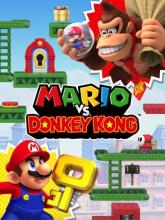
Still, “MvDK” looks objectively decent. The uncomfortable mix of sprites and low-res pre-rendered-polygons-turned-into-sprites from the GBA original have been replaced with a fully 3D world with acceptably animated characters. Textures and polygons are relatively simple and clean, giving the entire game a toy-like appearance, that jibes well with the overarching theme.
Audio is fairly average as well. Charles Martinet gives one of his final performances as Mario, and actually speaks a number of complete sentences, for once... over and over and over in the most formulaic way possible. Donkey Kong has a voice as well, but never actually says “words,” but grunts and growls in a very non-ape-like way.
Technically, I can’t complain about anything regarding “MvDK.” The whole game is on the cartridge, it includes a decent amount of bonus content. It even has a new “casual” mode that adds checkpoints to the stages. But, honestly, that’s the bare minimum for a full-priced remake.
Story
Whilst sitting in his jungle treehouse one day, Donkey Kong, the big, dumb ape, happens to see an ad on his banana-powered TV for a collection of new Mini-Mario wind-up toys marketed by the tubby plumber himself. Immediately overcome with a hoarding lust, DK heads to Mushroom City to buy all the Mini-Marios he can.
Unfortunately for the big ape, he’s late to the party, and the toys are all sold out. Flying into a savage rage, he breaks into the factory where the toys are made and absconds with every last one of them as they come off the assembly line, stuffing them into a large burlap sack – along with a variety of gift-wrapped boxes – before running off.
Not one to sit idly by, Mario sets off in hot pursuit to retrieve the toy shipment and put DK in his place. What follows is a not-so-merry chase through 8 different worlds (some of which are ACTUALLY NEW for the Switch remake!), before Mario must ultimately confront DK at a construction site highly reminiscent of the final level of the original “Donkey Kong.”
But wait! After his ignoble head-bashing, DK re-steals all the toys Mario just got done taking back, revealing that the game is actually twice as long as it appears on the surface. Will Mario and his oldest rival ever come to a detente regarding toy hoarding? How will DK pay for his crimes? With bananas?
I still have no idea how to keep track of play time on the Nintendo switch, but with each of the game’s 16 worlds taking under an hour to get through, plus two major boss battles and two Expert worlds full of optional bonus challenges, I’d say 15 hours is a good estimate for how much time a normal person will get out of “MvDK.” An abnormal person, however, will probably obsess over the time trials that unlock for every level after completing the game... but I have absolutely no interest in that.
Gameplay
“MvDK” offers a sequence of bite-sized platforming puzzles that ultimately ‘feel’ like the type of thing that is specifically designed for a dedicated handheld – not a hybrid device like the Switch or Steam Deck – in that they are extremely short and can be popped-off like little snacks in very little time. For the first half of the game, Mario follows DK through a sequence of two-screen stages, where the first screen requires Mario to retrieve a key in order to follow DK through a locked door, while the second screen requires Mario to retrieve a dropped Mini-Mario wind-up toy in a gachapon ball. Each stage is timed, with the timer extending upon going through the door. Likewise, each stage contains three gift-wrapped boxes as optional pick-ups – invoking the phantoms of Pauline’s dropped purse and parasol – that will grant the player a ‘Perfect’ completion and a Star for each level where they are all collected. All three gifts must be collected in a single run to ‘count,’ and the Stars exist primarily to unlock the Expert bonus stages.
Each world in the first half of the game features 6 of these two-screen stages, as well as a Minis stage and a Boss stage. The Minis stages are completely different from the normal stages and feel a bit like the old ‘Lemmings’ games instead of anything related to Mario or Donkey Kong. All 6 of the Mini-Mario toys retrieved in that world become active and will mindlessly follow Mario – or attempt to follow Mario – as he leads them through a stage with the ultimate goal of guiding all 6 of them to a waiting toybox, while (optionally) picking up tiles with the letters “T,” “O,” and “Y” on them in order to earn a Perfect Star. I feel like this is some sort of social engineering, trying to teach kids to put away their toys...
Boss battles see Mario facing off with DK. Unlike any other stages, Mario doesn’t die in one hit, but has a health bar equal to the number of Minis he managed to box-up in the preceding stage, while DK universally has 4 (NOT 3!) units in his health bar. These Boss fights are never direct confrontations, but instead focus on DK commandeering some piece of machinery and randomly operating it to hinder Mario, while Mario tries to grab a barrel, trash can, piece of fruit, or minion to chuck at DK’s fat, empty head.
The second half of the game mixes up the formula a bit. Instead of 2-screen stages, each stage is on a single screen, and instead of retrieving an inactive Mini, Mario must snag an active Mini, who is also carrying a key, in order to unlock the door and exit the stage. Thus the second half of the game combines both platforming and lemming management – though thankfully with only one lemming at a time.
In general, I found the stages to be well-designed and occasionally though provoking. It was nice to see the return of platforming mechanics that debuted in both the original “Donkey Kong” and “Donkey Kong Jr.” However, I did not particularly enjoy the return to the stiffer and clunkier controls that were a hallmark of those games. Mario does have a variety of acrobatic moves that belie his general slow movement speed, lack of sprinting, and occasionally weak aerial control, which can be incredibly frustrating when they ‘go off’ by accident (the backflip is especially tricky to pull off on purpose).
There is also some weird inconsistency with the challenge presented throughout the game’s stages. While they are universally short, some of the stages – randomly scattered throughout the entirety of the game – are significantly trickier than others, with trap, obstacle, and enemy placements that can quickly and easily kill Mario over and over and over, while many other stages pose no threats whatsoever.
Overall
Between the overly-sanitized corporate presentation and lack of personality, its overly formulaic nature, and excessively small-scale gameplay, there’s nothing really “wrong” with this remake of “Mario vs. Donkey Kong,” but at the same time it doesn’t feel as ambitious as the insanely good “Donkey Kong ‘94” that proceeded it. This is not the type of game that’s worth the full asking price Nintendo wants for it, in spite of the addition of new content not in the original Game Boy Advance version. Still, if you can find a used cartridge or get it on sale, it’s an adequately fun way to kill a dozen hours or so, just don’t set your expectations anywhere close to the likes of “Donkey Kong ‘94,” “Super Mario Odyssey,” or “Super Mario Bros. Wonder.”
Presentation: 3/5
Story: 3/5
Gameplay: 4/5
Overall (not an average): 3.5/5

