

Rating of
3.5/5
A Timeless Tale of a Boy and His Rage-Monster
Nelson Schneider - wrote on 02/10/26
Way back in 2005, during the heyday of the PlayStation 2, as it carried the banner of the 6th Generation after the Gamecube dropped off and the Xbox failed to start, Sony was beginning to think of itself as a first-party publisher, not just a platform runner who courted third-party exclusivity through favorable partnerships and regulations – which was why the original PlayStation dominated. So after a few moderately successful niche titles like “ICO” and “Ape Escape,” Sony, full of its own hubris, began to set its sights higher, developing an uncontrollable desire to create big-budget games with eye-popping visuals that – they believed – would solidify their consoles as THE place to go for THE best games. That fateful year, Sony brought forth both their most pretentious game, “Shadow of the Colossus,” as well as a definitively Western, definitively “M”-rated new IP from their Santa Monica studio, ‘God of War.’
The original “God of War” would go on to spawn two direct sequels as well as a prequel and a couple of handheld spin-offs designed for the ill-fated PlayStation Portable, but the series ultimately went dormant in 2013 as Sony focused its development efforts elsewhere after the catastrophic life of the PlayStation 3 and two failed handhelds. As someone who was GREATLY invested in Greco-Roman mythology and history, having just graduated with a Master of Arts degree in the subject a few months after the release of the original “God of War,” I really couldn’t have cared less about it. Instead of a ‘Classics game,’ I simply saw it as another annoying, combo-based Beat ‘em Up like the rebooted “Ninja Gaiden (Sigma)” and recently-debuted “Devil May Cry,” which looked like the exact opposite of what I wanted out of a videogame.
I still have never played any of the older ‘God of War’ titles, but the promise of a slowed-down, story-based reboot of the series in the 2018 “God of War” - which we will refer to as “Dad of Boy” in honor of the late, great career of once-relevant games journalist, Jim Sterling - somewhat piqued my interest, even though members of the Gaming community were referring to this new take on the IP as ‘Soulslike,’ without truly understanding what that term implies. Still, with zero interest in a PlayStation 4 and no long-running obsession with ‘God of War’ in general, “Dad of Boy” had its work cut out for it in order to force its way into my sight cone. That final push came when Sony decided to start porting some of its high-profile first-party games to Steam and GOG in an attempt to garner more sales in a world where PlayStation was no longer the uncontested top-dog of consoles and where PC gaming was beginning to eclipse the entire console market.
One 50% off sale later, and I found myself with a copy of “Dad of Boy” sitting in my Steam account, but with very little motivation to actually get to it, as a fan of neither the ‘fast’ Action gameplay of the older titles, nor the ‘slow’ pseudo-Soulslike Action promised by the reboot. Thus “Dad of Boy” was a no-brainer choice for one of my 2026 Backlog Ablution titles to work through under penalty of monetary punishment.
Presentation
“Dad of Boy” is something of an outlier in modern game development, as it is built in a proprietary in-house game engine instead of using Unreal or Unity to handle under-the-hood mechanics. Of course, developers who put in the effort to make a proprietary engine for their projects tend to end up with projects that are visually impressive, and “Dad of Boy” definitely follows that trend. Sony’s Santa Monica studio really outdid themselves with the PC port of the game, providing tons of visual options that simply weren’t available for players on the PlayStation 4 – or even the PlayStation 5 via its set of magical ‘enhancements.’ That said, the default settings the game selected for me were actually pretty bad, rendering the game at a super-low DOS-era resolution, then upscaling it via nVidia DLSS to my gaming rig’s desktop resolution of 1080p. I thought the game looked rather blurry and soap-operatic until I realized what was going on in the settings and changed it to render at 1080p natively at Ultra settings (on an RTX 3060 graphics card), then letting my Bravia’s built-up upscaler take it the rest of the way to 4K. In general, “Dad of Boy” looks gorgeous, with detailed, well-animated characters; lush, lavish environments; and a grim-and-gritty world that is simultaneously bleak, surreal, and fantastical.
Unfortunately, the visuals are really the game’s main selling point. The audio is highly understated, with full voice-acting that’s mostly ‘good,’ but features some odd choices in accents – Kratos does not sound Greek, Boy sounds American, and none of the supporting characters sound the least bit Scandinavian. However, the soundtrack is absolutely abysmal, or, rather, non-existent. Nearly the entire game is unaccompanied, with a soundtrack of silence, while in the few moments when it tries to use background music for dramatic effect, the music fails to come out of the background and become memorable in any way.
Technically, at least, the PC port of “Dad of Boy” is very solid. It supports Xinput out of the box, runs smoothly on fairly old (as of 2026) hardware, and is a tidy, glitch-free experience. It also provides the much needed ability to re-map the controls – though not to the extent I would have liked – as well as a plethora of difficulty settings, ensuring that anyone who wants to get as much enjoyment out of the game as possible doesn’t actually have to ‘git gud’ at the combat, while those who are obsessed with perfecting their performance are free to do so without bothering the rest of us.
Story
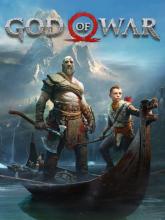
“Dad of Boy” generally seems to assume that players will be familiar with the preceding games in the series, which is a bad call for a game with a rebooted, non-numerical title. Thus, we don’t get any recap cutscenes or ‘Previously, on ‘God of War’’-style lore dumps. Instead, we are simply introduced to a surly bald man with red tattoos who is out in the woods chopping down trees with his son... using an incredibly fancy axe and taking down full timbers in just a few blows. Upon hoisting a full timber on his shoulder, tossing it into a creek, and towing it behind his canoe back to his home base, we finally learn why Surly-Bald-and-Tattooed needs this wood: He’s building a funeral pyre for his wife, as his son performs some Viking last-rites ritual before the pair cremate her.
Shortly after their somber, firelight vigil, our protagonists are confronted by a mysterious Stranger who appears outside their hut, and is apparently searching for something, but is cagey about exactly what. The Stranger and Surly get into an epic fisticuffs battle, which ends only after the Stranger gets a mountaintop dumped on him and an earthquake sees the entire battlefield collapse into a fissure. Surly magically heals himself of the wounds received during the beat-down and returns home to retrieve his son, as they both set out to fulfill their wife’s/mother’s final wish: To have her ashes scattered from atop the highest mountain in the realm.
Through indirect revelation, we learn that Surly is, in fact, a Spartan from Greece named Kratos, who is a demi-god, the Son of Zeus, and an expatriat from his own land after murdering the entire pantheon of other deities. We also learn that the Boy – who is nearly always referred to as ‘Boy’ instead of his given name, Atreus – is also a demi-god, but that Kratos wishes to keep this fact a secret from the boy, since both Kratos and his wife were of the opinion that there are no good gods, and that knowing his nature would only burden/corrupt the boy.
Thus, Kratos and Atreus have their task before them and set out into a uniquely-bleak vision of ancient Scandinavia on the verge of the End Times of Ragnarok. Along the way, they meet a couple of eccentric dwarves, a mysterious Forest Witch, and... surprisingly few other gods. From what little I know of the previous story of the series, I was expecting Kratos to murder his way through the entire Norse pantheon, culminating with Odin... but he actually only ends up fighting a couple of the Norse gods, and only kills one of them who anyone has actually heard of. Indeed, the Norse gods seem perfectly content to let Kratos and Boy do their thing – or maybe they’re just oblivious.
Instead of being based mainly in wholesale slaughter, “Dad of Boy” paints a picture of a reformed Kratos who is trying to move beyond his past actions as a psychotic raging murder-hobo in order to set a good example for Boy. Indeed, the most compelling character development arc in the entire narrative revolves around how Atreus’ behavior changes before and after learning his true nature, and how he resolves the conflict between his nature and the person he really wants to be – a story arc that is paralleled in a dark inversion by Baldr, the game’s main antagonist.
“Dad of Boy” doesn’t really follow the archetypal ‘Hero’s Journey,’ but rather paints a picture of a straight-forward task that is constantly interrupted by an ever-escalating series of obstacles. Just when Kratos and Atreus reach the peak of the highest mountain in the realm, after fighting through hordes of undead and navigating the shores of a huge lake which is the home of the World Serpent, the duo discover, to their chagrin, that the highest mountain in the realm isn’t the highest mountain in the realm, as the actual highest mountain is in the parallel world of Jotunheim, Land of the Giants, which has been sealed off since Odin, Thor, and the Giants had a bit (or rather a LOT) of a falling-out. Thus, Kratos and Atreus must navigate the entire breadth and depth of all the realms connected to the Norse World Tree (represented as some sort of sci-fi quantum woo-woo) in order to perform what seemed like such a simple task at the outset.
In general, I’m not entirely in love with the way “Dad of Boy” handles its source material. While Thor was always portrayed as a hero of the people, somewhat like a mix of Hercules and Jesus, in “Dad of Boy,” he’s painted as an absolute monster – and never actually appears on-screen or given a chance to defend his actions. Indeed, the entire shtick that underpins the ‘God of War’ series seems to be taking the wind out of ancient pagan pantheons and reframing the gods’ actions to make them look absolutely irredeemable. Though, I suppose taking a dump on the Norse pantheon is in-line with the thought process of the Catholic chronicler responsible for preserving our only surviving records of these myths, so it is what it is.
I also feel like the story arc between Kratos and Atreus moves at a very inconsistent pace. At first it was almost triggering how similar this experience was to my own youth, growing up as a Boy Scout under the tutelage of my own psychotic rage monster, but the early part really drags, while the part where Atreus begins to figure out who he is feels incredibly rushed. Meanwhile the ‘shocking revelation’ during the ending sequence, as well as the fact that “Dad of Boy” is really only the first half of a complete story, leaving a fairly severe cliffhanger ending, left me feeling more annoyed than anything else in the story.
It took me about 50 hours to get through the game, scouring all of the side paths for hidden goodies and confronting the optional super bosses. However, there were two areas with extra content that felt incredibly tacked-on and irrelevant that I didn’t enjoy for the initial pass, and thus didn’t fully complete for the Achievements. I feel like there was probably about 20 hours worth of story material in the entire game, and that it was stretched and padded unnecessarily, probably in the service of chopping things off narratively in service of the pre-planned sequel. I wouldn’t say that I was ever ‘bored’ with “Dad of Boy,” or that I never looked forward to finding out ‘what happens next.’ However, I was ultimately left wanting by the entire experience, due to its pacing, tone, and scale – or lack thereof.
Gameplay
Let’s just get this out of the way at the beginning: “Dad of Boy” is NOT a Soulslike. There is no stamina management, and most importantly, there is no weirdly punitive death system involving currency loss or massive gaps between checkpoints. There is, however, a rather slow, clunky combat system built around light attacks, heavy attacks, blocks/parries, and dodge-rolls. That, in itself, is enough to differentiate this game from the original ‘God of War’ trilogy and spinoffs, which – according to other people’s accounts, since I have never played any of them – focused on fast, fluid movement and long strings of complex combos.
Thus, it should come as no surprise that I didn’t find the combat in “Dad of Boy” to be particularly fun or compelling. For the first half of the game, Kratos doesn’t even have access to his traditional chain-blade weapons, but instead uses a magical axe that freezes enemies and can be called back to his empty hand from anywhere. Axe combat is the central meat-and-potatoes of this game, and adds another wrinkle to the standard combat template with Kratos’ ability to use the axe as a thrown weapon, spiking it into enemies, then violently calling it back, causing it to deal damage both going and coming. The chain-blades also have a ranged thing going, after unlocking them via a story beat, but that particular mechanic has such poor range that it’s typically relegated to solving a handful of environmental puzzles rather than yanking enemies around in battle.
I think the main reason combat feels so slow, clunky, and lugubrious in “Dad of Boy” is due to a combination of the field of view and the fact that the game’s over-the-shoulder trailer camera sticks a little too close to the big guy, making spatial awareness more difficult than it should be. To make up for this, Boy, as well as another character who joins the team, will yell at Kratos when he’s about to be biffed from off-camera, but his stiff movement and the camera’s lack of responsiveness rarely allow the combat to flow, but rather force Kratos to respond to things he can’t see by dodging or rolling out of the way, then re-situate himself afterwards. There is also a ‘quick turnaround’ button in the game, but I always felt like it was impossible to take my thumb of the left stick to tap down on the d-pad to use it without likewise getting biffed in the process.
Aside from the fairly bog-standard Beat ‘em Up style combat, “Dad of Boy” features a suite of pseudo-RPG mechanics that attempt to add Action/Adventure depth to what would otherwise be a fairly basic game, but ultimately provide too many dead-end ‘trap’ options in equipment, and a leveling/skill system that unlocks new tricks too slowly and relies on fake damage multipliers based off the difference in levels between Kratos (specifically his gear) and his enemies. Kratos’ level isn’t determined by experience points, but is tied entirely to his equipped weapons and armor. Early on, it’s easy to gain levels as expected, simply by acquiring the key items required to upgrade the axe, while chest armor, waist armor, gauntlets, and amulets feel entirely optional. However, there are numerous side paths throughout the game that hide extra upgrades – either direct power-ups or currency/crafting materials for making/upgrading this armor – that will occasionally be blocked off by enemies that will one-shot Kratos and take little-to-no damage unless the player has been paying attention to upgrading, replacing, and otherwise min/maxing Kratos’ equipment. What is especially frustrating about these scaled enemies is that they are harder than any of the story bosses (and, depending on the level gap, even harder than the optional bosses) simply due to the damage multiplier that goes into effect when there’s a significant level difference. Kratos’ actual stats – as measured numerically on his character sheet – don’t matter at all compared to pumping his ‘overall’ gear level as high as possible. This kind of fakery pissed me off in “Destiny 2” and “The Witcher 3,” and it’s no less off-pissing here.
That said, the most enjoyable aspect of “Dad of Boy’s” gameplay was, from my point of view, the pseudo-open-world-style exploration which leads to numerous hidden loot caches, puzzles, and side quests. None of these puzzles are particularly thought-provoking, but the environmental designs that hide all of these secret side areas are excellent, and make it feel worthwhile to run off the beaten path whenever possible. Unfortunately, “Dad of Boy” is definitively NOT an open-world game, and takes great pains to lock its fast travel system until far, far too late in the story. It is also a shockingly small world, with most of the action taking place around the shores of a single lake, while travel to “other realms” feels like just dipping a toe into them instead of actually exploring them in any meaningful way.
On the other hand, the least enjoyable content in the game comes in the form of optional realms and super bosses. There are two entire planes of existence which are entirely optional – Muspelheim, the Realm of Fire and Niflheim, the Realm of Mist. Muspelheim takes the form of a long, tedious series of combat arenas with specific modifiers to make otherwise normal fights much more annoying (i.e., if you don’t kill all the enemies at roughly the same time, the dead ones will come back to life while you’re killing the last one). Niflheim is even worse, as it is a Roguelike-inspired mini-dungeon with a random layout each time Kratos enters, where the sole objective is to collect an unreasonable amount of mist samples for one of the dwarf blacksmiths and to unlock some stuff in the dungeon’s central room. I only engaged with these two realms enough to deal with their Valkyries, and that was enough. The Valkyries are the other optional content, consisting of a string of 9 super-boss battles that range from ‘sweaty’ to ‘tooth-gnashing.’
Overall
What can I say about “God of War” “Dad of Boy” after playing through it? Did I love it? No. Did I like it? Kinda-sorta. Am I looking forward to Sony porting the sequel to Steam so I can resolve the cliffhanger ending? No, not really. “Dad of Boy” is a painful example of Sony’s current first-party design philosophy: It’s gorgeous and has high production values, but is ultimately not particularly fun or enjoyable as interactive media. If I could watch a 3-hour movie of the events of “Dad of Boy” and its sequel, “Dad of Boy: Ragnarok,” I’d opt for that. However, as a videogame series, I think I’m going to be one-and-done with this one.
Presentation: 4.5/5
Story: 3.5/5
Gameplay: 3/5
Overall (not an average): 3.5/5

