

Rating of
3/5
All Style, No Substance
Nelson Schneider - wrote on 12/26/25
Back in the 1980s, a Japanese publisher called Technos (with a long mark over the ‘o’) made a splash with a variety of arcade games, mostly falling neatly within the Beat ‘em Up genre. Technos was the original owner of one of the biggest IPs in the genre, ‘Double Dragon,’ but was also responsible for another IP set within the ‘Double Dragon’ universe, ‘River City.’ The original game, “River City Ransom,” was one of those impossible ‘Nintendo Hard’ NES games that wasn’t particularly fun or good in any way, but it had a unique graphical style, and Nintendo Power Magazine spilled copious amounts of editorial ink in making sure people knew about it.
Personally, I never played the original “River City Ransom,” and never had any interest in it. Indeed, my interest in Beat ‘em Ups mostly drifted in Capcom’s general direction at the time, to the point where I have played all three of the SNES ‘Final Fight’ games, but the only ‘Double Dragon’ game I ever owned/played was the one that crossed-over with ‘Battletoads,’ so I was surprised when, in 2019, WayForward – the quasi-Indie development studio behind the ‘Shantae’ series as well as NES-era remakes like “DuckTales Remastered” – was tapped by Arc System Works, the current ‘River City’ rightsholder, to create a sequel to “River City Ransom” called “River City Girls” (“RCG”). Interestingly enough, “RCG” wasn’t the first sequel to “River City Ransom,” as a Japan-only SNES release from 1994 was subsequently localized by WayForward and released to the wider world in 2022 as “River City Girls Zero.”
In spite of my lack of interest in Technos’ back catalog of vintage NES and SNES games, Chris loves both NES/SNES era Beat ‘em Ups and high school girls, so it was inevitable that we would find ourselves couch-cooping through “RCG” at some point, especially considering that cooperative 2-player campaigns have been a staple of the series since the very beginning. We found “RCG” to be largely what I expected it to be: A slick, gorgeous package by WayForward filled with shallow, repetitive gameplay that barely feels like it has evolved at all since Technos went bankrupt in 1996.
Presentation
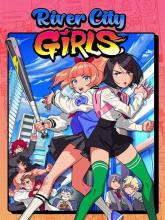
“RCG” is made in Unity, which is usually the engine of choice for new, inexperienced developers, resulting in a lot of the engine’s quirks going uncorrected. WayForward is NOT inexperienced, however, and the result is a game that feels just as polished as if it was fully hand-crafted from scratch. This polish is largely a result of the game’s incredible presentation, with full anime-style cutscenes, manga-panel-style cutscenes, great 2D sprite animation, and detailed backdrops. Everything in the game looks very good and the new art style looks decidedly less... odd than the original boxy-with-big-heads style of the classic ‘River City’ games.
The audio complements the visuals with fantastic, fully-voiced dialog (by anime dubbers, naturally), and a driving soundtrack that fully complements the game world’s insane levels of baseline violence. The soundtrack could be better though, as there weren’t any particularly memorable tracks that I felt a desire to listen to outside of the game.
Technically, “RCG” is perfectly serviceable, with native Xinput support out of the box, easy compatibility and automatic detection of different generations of Xbox controller, and drop-in/drop-out campaign coop. The game performs perfectly well, with smooth frame rates at 4K resolution and never a single crash, hitch, glitch, or hiccup during my time with it. But it is a pretty basic 2D, sprite-based game without a lot of different variables or subsystems to keep track of, so not having technical issues shouldn’t be considered much of an accomplishment.
Story
Apparently, the ‘River City’ IP is known as ‘Kunio-kun’ in Japan, as the running narrative revolves around a a post-WWII-style Japanese juvenile delinquent named Kunio, who is constantly getting into fights with other juvenile delinquents, gang members, Yakuza, and worse. “RCG” flips the script a little bit, as instead of revolving around Kunio and his best friend, Riki, it revolves around two girls who think they’re Kunio’s and Riki’s girlfriends. Like their male counterparts, Misako and Kyoko are juvenile delinquents who attend River City High School, located in a city filled with casual violence, dirty cops, and blatant Yakuza activity, among other things.
While sitting in detention one day, Misako and Kyoko receive texted photos of Kunio and Riki getting into an unmarked white van, which they interpret as the boys being kidnapped. The girls immediately spring into action, break out of the school, and start a rampage all across town, shaking down everyone they can think of for info about their boy toys’ abduction.
While the premise is about as basic as you can get, with ‘save the kidnapped love interest’ being a staple of the NES and SNES eras where Technos games were still relevant, the sequence of nonsensical encounters as the girls beat up one possible source of information about the boys’ disappearance, only to be directed in another completely non sequitur direction each time makes the overall narrative feel like a farce or a satire. Of course, the not-so-surprising twist ending, in which it is revealed that the ‘kidnapping’ was a big misunderstanding and that Kunio and Riki barely seem to know Misako’s and Kyoko’s names, let alone considering them love interests, only cements the absurdity.
Thankfully, “RCG” isn’t a particularly long game, so the joke doesn’t get stretched out too far or last too long, with a single coop playthrough taking about 5 hours. Of course, completing the game as the girls unlocks a New Game+ mode where it’s possible to replay through the game as the boys, with both playthroughs necessary to unlock the not-so-secret bonus boss, but I don’t think either Chris nor I enjoyed the core experience enough to want to double the amount of time we’d spend with it.
Gameplay
“RCG” is a fairly bog-standard retro-style Beat ‘em Up that doesn’t really change much from the genre’s basics. Each of the four playable characters has slightly different move-sets that are similar enough that they all conform to the same basic inputs. Each character has a weak attack, a strong attack, a block (that only works as a parry, and not a combo-breaker), and a special attack (that consumes a meter that is filled by landing weak/strong hits) button. These basic attacks can be combined with simple directional inputs, jumps, or dashes to expand the characters’ repertoires of moves, along with stomps against downed enemies and grapples/throws against stunned enemies.
The starting set of moves for each character is incredibly basic, but can be expanded by gaining levels and collecting money from fallen foes and spending it at a Dojo to add hits to the basic weak combo, directional attacks, and specials. The leveling system is incredibly basic, with characters gaining a little bit of extra health, damage output, and defense with each level-up, and maybe one of the handful of move unlocks not tied to a Dojo purchase. The level cap is apparently 30, but Chris and I only managed to hit level 18 by the time we defeated the final boss.
In addition to the Dojo, money can be spent on accessories (which can be worn 2 at a time) that add incredibly weak buffs, recovery items, or passive items. Unfortunately, the game does nothing to explain its consumables system, which lead me and Chris to having a worse time than we should have. Apparently, eating each consumable healing item gives a character a permanent stat boost the first time they eat it, while the magazines that advertise themselves as preventing weapon pickups of various types from breaking must be KEPT and NOT USED in order to apply their effects. Because we weren’t collecting the permanent stat buffs from food, I noticed that we were dealing significantly less damage toward the end of the game, making every fight turn into a long, drawn-out slog, where simply ignoring the enemies and running past them was more efficient than defeating them.
Outside of its simplistic leveling system and poorly explained consumables system, “RCG” feels a bit like a hybrid of a retro-style level-based Beat ‘em Up and a Metroidvania, as the girls exist within a large, interconnected map, and are free to backtrack at will. However, unlike a real Metroidvania, access to new or previously-blocked areas isn’t tied to collecting power-ups or upgrades, but instead tied to the narrative, with the plot railroading the players to where they are supposed to be instead of giving them the freedom to wander around and discover fun stuff. There’s not all that much to really discover anyway, outside of a handful of breakable busts (for an achievement).
Really, the only memorable thing about the gameplay in “RCG” is the boss fights. Each one is unique, and they’re mechanically complex enough to take several attempts, but not frustrating enough to cause rage-quitting (even though losing to a boss results in the characters losing a chunk of their accumulated cash, which makes grinding up the funds to buy all the food items for the secret stat boosts take even longer).
Overall
While it’s robed in an immaculately-slick presentation thanks to the artistic folks at WayForward, “River City Girls” ultimately feels more like a relic of the era that spawned it. All of the attempts at adding ‘depth’ to the shallow gameplay core of a vintage Beat ‘em Up fell short, here, with end result feeling like a repetitive slog in spite of its incredibly brief runtime. If Epic Games decides to give away the sequel, Chris and I will probably coop it, but this just isn’t an IP that I’d be willing to pay for.
Presentation: 4.5/5
Story: 3.5/5
Gameplay: 2.5/5
Overall (not an average): 3/5

